

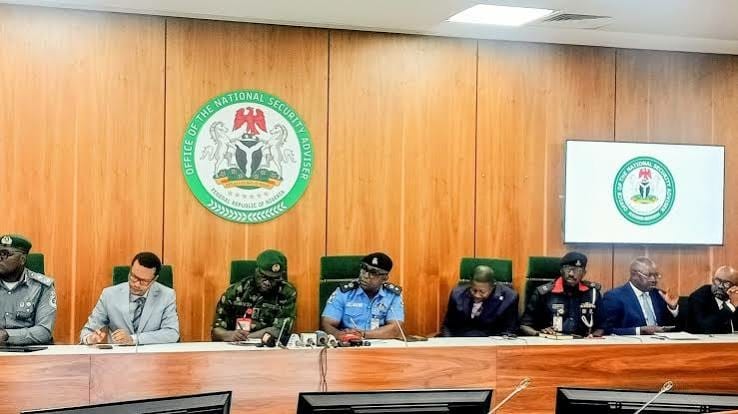
The Defence Hleadquarters (DHQ) has dismissed reports of a ceasefire agreement with Boko Haram terrorists, insisting that military offensives against insurgents, bandits, kidnappers and other criminal networks remain relentless across the country.
The military also disclosed that troops neutralised 435 terrorists and bandits, arrested 809 suspects and rescued 717 kidnapped victims during 588 security operations conducted across various theatres between September and October 2026.
The Director of Defence Information, Major-General Samaila Uba, made this known during a joint briefing by defence, security and intelligence agencies organised by the Office of the National Security Adviser (ONSA) in Abuja.
Responding to questions on alleged negotiations or ceasefire arrangements with Boko Haram, Uba categorically dismissed the claims, declaring that the Armed Forces of Nigeria had not entered into any ceasefire agreement with the insurgents.
He said the military’s operational successes, including the elimination of terrorist commanders, arrests of suspects and rescue of abducted persons, demonstrated its continued commitment to dismantling criminal networks.
“On the issue of whether there is a ceasefire with Boko Haram, I want to make it clear that there is nothing like a ceasefire.
“Considering the terrorists neutralised, suspects arrested, victims rescued and other successes recorded across our operations, it is clear that we are not relenting.
“We will continue to sustain pressure on these criminal elements,” he said.
Uba stressed that military operations were not restricted to Boko Haram and the Islamic State West Africa Province (ISWAP), but also covered kidnappers and other criminal groups threatening the lives and security of Nigerians.
He warned that anyone involved in criminal activities would either be eliminated through lawful military operations or brought to justice.
On reports of insurgents relocating to other parts of the country, the Defence spokesman said such movements reflected the pressure military offensives had mounted on their previous strongholds.
He, however, warned that the Armed Forces would not allow the terrorists to establish new operational bases elsewhere.
According to him, the military is already mapping areas where fleeing insurgents may have relocated and deploying proactive measures to prevent them from gaining fresh footholds.
Uba cited the recent neutralisation of a high-ranking terrorist in a forest location as further evidence that criminal elements would find no safe haven anywhere in Nigeria.
Providing details of military achievements, he said troops, under the strategic leadership of President Bola Tinubu and the Chief of Defence Staff, General Olufemi Oluyede, recorded significant operational successes within the two-month period.
He listed some of the high-profile terrorist commanders neutralised to include Ali Mandara, Abba Gajiri, Habu Ikkima, Nakif Yana Faruk, Commander Gogore and Abdussamad Ohida.
The Defence spokesman further disclosed that 198 insurgents voluntarily surrendered during the period, while 809 suspects were arrested in various operations.
Among the 717 rescued victims were 20 prospective members of the National Youth Service Corps (NYSC) in Owerri, Imo State, and 11 persons abducted in Danko-Wasagu, Kebbi State.
He identified Buniyadi, Baga, Kukawa, Bittai and the Owo forest as some of the locations where troops recorded major tactical breakthroughs, significantly disrupting terrorist networks.
Uba added that troops recovered 5,666 arms, ammunition, explosives and improvised explosive devices (IEDs), alongside other logistical materials used by criminal groups.
In the Niger Delta, he said security operations against oil theft and illegal refining led to the destruction of 57 illegal refining sites and the recovery of more than 1.061 million litres of stolen petroleum products.
He noted that the operations were contributing to the protection of critical national assets and efforts to improve Nigeria’s crude oil production.
While acknowledging that security challenges persisted in parts of Borno, Yobe, Taraba, Katsina, Kwara, Zamfara, Sokoto, Plateau, Benue, Niger, Oyo and Kaduna states, Uba said troops were strengthening their operational strategies through coordinated clearance operations, patrols and deeper inter-agency collaboration.
He also linked the ongoing restructuring of the Armed Forces, including the establishment of new formations, battalions and operational units, to efforts to close security gaps and improve military presence across the country.
According to him, the adjustments to the military’s order of battle are designed to address emerging security threats and enhance operational effectiveness.
On regional security cooperation, Uba disclosed that a recent high-level forum on repositioning the Multinational Joint Task Force (MNJTF) examined the implications of the withdrawal of some countries from the Economic Community of West African States (ECOWAS).
He said the forum brought together serving and former force commanders, academics and other stakeholders to review past achievements, identify operational gaps and explore diplomatic options for strengthening regional security cooperation.
He added that implementation of some recommendations from the forum had commenced, with expected results to become evident in the coming months.
Beyond military operations, Uba said the Defence Headquarters was promoting indigenous defence manufacturing and technology transfer through its participation in the Africa International Defence Exhibition 2026.
He further disclosed that the DHQ had continued to prioritise the welfare of serving personnel and veterans through engagement programmes and the launch of a Defence Discount Shop in partnership with Konga and Zinox.
He maintained that the Armed Forces remained committed to sustaining pressure on terrorists and other criminal elements until peace and security were restored across the country.

