

Joseph Moses MMoses Mawunyinka
Nigeria has called for a new model of global engagement with Africa based on respect for national sovereignty, strategic autonomy, domestic resource mobilisation and investment in viable infrastructure projects.
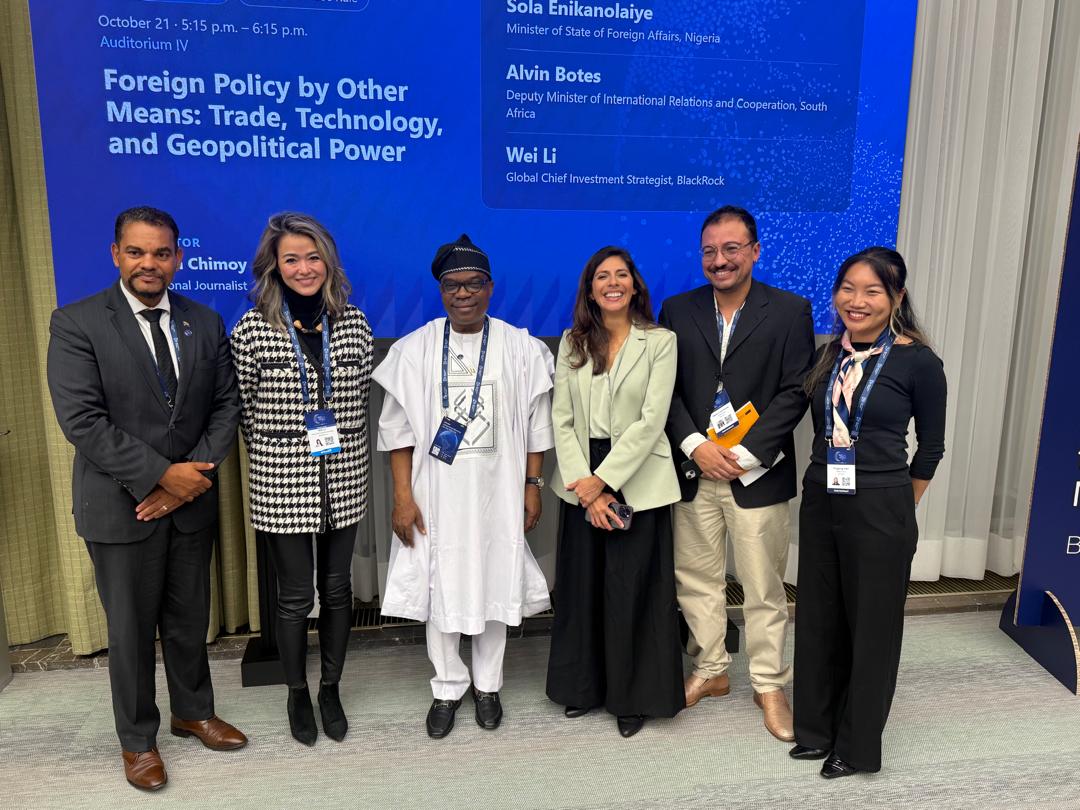
The Minister of State for Foreign Affairs, Ambassador Sola Enikanolaiye, made the call while representing Nigeria at the Berlin Global Dialogue 2026 in Germany, where he participated in a high-level panel on foreign policy, trade, technology and geopolitical power, as well as a policy lab on infrastructure and investment.
Enikanolaiye said Africa was determined to shape its development priorities through mutually beneficial partnerships that promote shared prosperity, mutual respect and commitment to the continent’s interests.
He noted that global diplomacy was moving away from rigid political alliances towards more pragmatic and transaction-oriented engagements, stressing the need for African countries to position themselves strategically in the changing international order.
According to him, Africa possesses significant resources and economic opportunities but must strengthen domestic investment to reduce excessive dependence on foreign capital.
Drawing lessons from the historical relationship between business and diplomacy, from the Royal Niger Company to multinational corporations operating after independence, the minister argued that foreign investment should complement rather than replace local resources.
Citing the international reach of Aliko Dangote’s business interests, he maintained that African countries must mobilise their own capital and strengthen indigenous enterprises to drive sustainable economic development.
“Foreign capital can only complement but cannot replace the kind of resources that we need,” he said.
The minister also highlighted the role of government in creating an enabling environment for private-sector growth, pointing to Nigeria’s peacekeeping interventions through the Economic Community of West African States Monitoring Group (ECOMOG) in Liberia and Sierra Leone as examples of how regional stability could support the expansion of Nigerian businesses across Africa.
On international relations, Enikanolaiye reaffirmed Nigeria’s commitment to strategic autonomy, explaining that the policy would allow the country to pursue its national interests independently of ideological differences among competing global powers.
He stressed that Nigeria’s foreign policy must protect national interests while creating opportunities for Nigerian companies to compete effectively in international markets.
Addressing natural resource management, the minister called for an end to the export of unprocessed minerals, urging African countries to prioritise local processing and value addition to generate employment, boost industrialisation and retain more economic benefits within their borders.
He disclosed that the Federal Government was requiring investors in the mining sector to establish local processing industries, with appropriate oversight to protect the environment and host communities.
According to him, lessons from the Niger Delta have reinforced the need to safeguard the rights of communities where natural resources are extracted.
On infrastructure development, Enikanolaiye identified reliable electricity, efficient intermodal transportation and expanded digital connectivity as essential foundations for increasing production, attracting investment and creating opportunities for Africa’s growing youthful population.
He also identified revenue generation through electricity metering as an investment opportunity for foreign partners seeking to support improvements in the continent’s power sector.
The minister said African governments were implementing reforms to attract investment through macroeconomic stabilisation, deregulation and the review of outdated laws.
However, he emphasised that attracting long-term capital required well-prepared projects, predictable regulatory frameworks, transparent procurement processes and credible risk-sharing mechanisms.
He identified the African Export-Import Bank, African Development Bank, ECOWAS Bank for Investment and Development, and the newly established African Credit Rating Agency in Mauritius as important institutions capable of supporting infrastructure financing through guarantees and blended finance arrangements.
Enikanolaiye further stressed the importance of regional economic integration, noting that Africa needed to increase intra-continental trade to build competitive industries and accelerate economic growth.
He cited the continent’s average economic growth of 4.3 per cent, with an ambition to reach seven per cent, alongside progress towards the ECO common currency, Nigeria’s National Single Window initiative and the Pan-African Payment and Settlement System (PAPSS), launched in January 2026, as measures that could strengthen economic cooperation.
He called for increased trade among African countries under the African Continental Free Trade Area (AfCFTA), noting that intra-African trade remained relatively low at about 16 per cent.
“We need to trade more among ourselves to develop competitive advantages,” he said.
The minister also advocated reforms to the international credit rating system, welcoming the emergence of the African Credit Rating Agency as a step towards strengthening the continent’s financial independence and improving access to affordable capital.
He linked Africa’s prospects in artificial intelligence and other emerging technologies to the availability of reliable electricity, noting that technological advancement would remain difficult without stable power supply.
On human capital development, Enikanolaiye called for a review of technical education curricula to align skills training with infrastructure and industrial needs.
He also urged African countries to explore diaspora remittances as an alternative source of development financing amid declining official development assistance, while highlighting ongoing Nigerian reforms aimed at improving the business environment.
The minister further pointed to China’s approach to infrastructure cooperation as an example of alternative engagement models available to African countries.
He concluded by calling for the mobilisation of long-term capital to support Africa’s development aspirations, reaffirming Nigeria’s commitment to fiscal discipline, transparency, democracy and the rule of law.
Meanwhile, Nigeria’s delegation held a series of engagements at Nigeria House in Berlin on behalf of President Bola Ahmed Tinubu. The delegation was led by Enikanolaiye and the Minister of Budget and Economic Planning, Senator Abubakar Atiku Bagudu.
As part of the engagements, Enikanolaiye and Nigeria’s Ambassador to Germany, Senator Ita Enang, held a bilateral meeting with Lesotho’s Minister of Foreign Affairs, Limpho Justice Tau, to explore opportunities for strengthening diplomatic and economic relations between both countries.
Discussions included the possibility of establishing a physical diplomatic presence for Lesotho in Abuja to deepen bilateral cooperation.
Tau commended Nigeria’s historic contributions to African liberation efforts and invited Nigerian industrialists, including the Dangote Group, to explore investment opportunities in Lesotho.
The meeting is expected to contribute to stronger diplomatic relations and expanded economic cooperation between Nigeria and Lesotho.

