

By Joseph Moses Mawunyinka
Nigeria has called for the meaningful inclusion of women in peace negotiations and stronger action against conflict-related sexual violence, warning that the continued exclusion of women is undermining peacebuilding efforts across Africa and other conflict-affected regions.
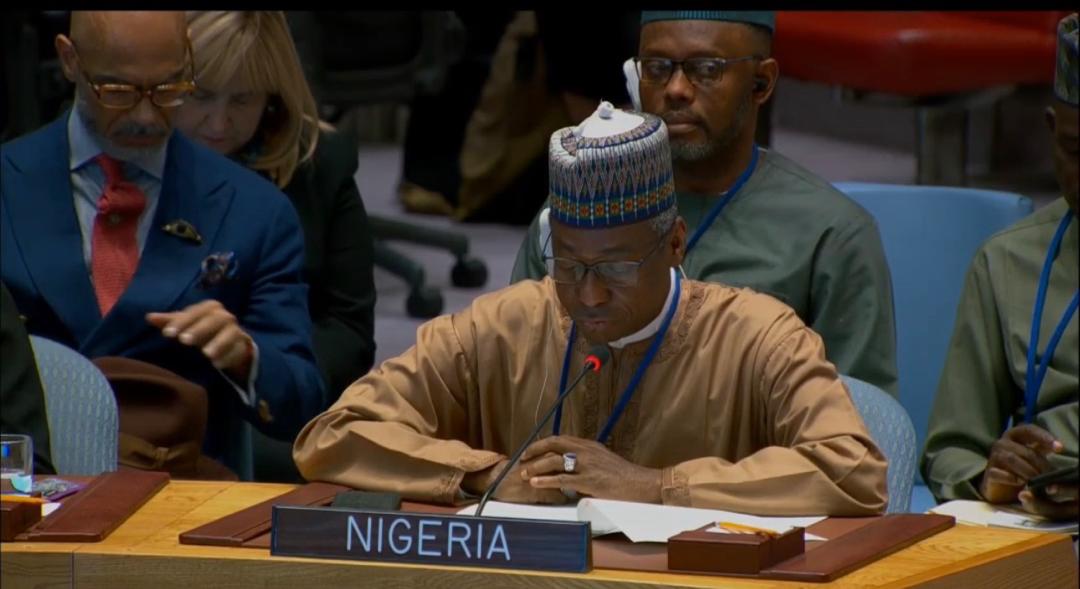
The country made the call at the United Nations Security Council (UNSC) Open Debate on Women, Peace and Security, held on October 27, 2026, at the UN Headquarters in New York.
The debate, convened under the theme, “Women, Peace and Security in the Next Quarter-Century: Fulfilling the Promise Through Implementation,” provided an opportunity for member states to assess progress and address persistent gaps in implementing the women, peace and security agenda.
Delivering Nigeria’s statement, the Permanent Secretary of the Ministry of Foreign Affairs, Ambassador Dunoma Umar Ahmed, welcomed the UN Secretary-General’s report on Women, Peace and Security but expressed concern over the continued marginalisation of women in UN-led peace processes.
He disclosed that women accounted for only five per cent of lead negotiators and 14 per cent of mediators across 57 negotiation processes in 2025, while only 10 peace agreements explicitly referenced women.
Ahmed also raised the alarm over reports that cases of conflict-related sexual violence had more than doubled since 2024, describing the development as particularly disturbing for Africa, where several conflicts remain on the Security Council’s agenda.
He identified the Sahel, Lake Chad Basin, Sudan and the Great Lakes region as areas facing serious security challenges, stressing that excluding women from peace negotiations weakens peace agreements, fuels renewed conflicts and threatens human lives.
The Permanent Secretary cited Nigeria’s experience in the North-East, where women and girls have suffered disproportionately from terrorism, abductions and displacement.
He, however, stressed that women remain critical to peacebuilding and recovery efforts, pointing to their contributions as community mediators, first responders and members of security forces.
Highlighting Nigeria’s commitment to protecting women and girls, Ahmed outlined several national and regional initiatives, including the implementation of the National Action Plan on United Nations Security Council Resolution 1325 and the strengthening of legal protections through the Violence Against Persons (Prohibition) Act.
He also highlighted Nigeria’s participation in regional efforts through the ECOWAS Regional Action Plan and the African Union’s Continental Results Framework on Women, Peace and Security.
To translate international commitments into practical results, Nigeria proposed three key measures.
First, it called for the institutionalisation of women’s meaningful participation in peace processes, insisting that their inclusion must become standard practice rather than an exception.
Nigeria urged the United Nations, African Union and Regional Economic Communities to systematically engage qualified women in mediation and peace negotiations, drawing on established networks such as the African Women Leaders Network.
It emphasised that women should not merely occupy seats at negotiating tables but must have genuine influence in shaping peace agreements and their implementation.
Second, Nigeria called for predictable and adequate funding for national and local action plans, particularly to support women-led organisations operating in conflict-affected communities.
It also stressed the need to preserve and strengthen gender expertise in peace operations, especially African Union-led missions financed under Security Council Resolution 2719, despite prevailing financial constraints.
Third, Nigeria advocated a survivor-centred approach to addressing conflict-related sexual violence, with greater emphasis on protection, justice and accountability.
Ahmed insisted that perpetrators must be held accountable, primarily through national justice systems, with appropriate international support.
He further called for survivors, including women and girls formerly held captive by terrorist groups, to receive medical treatment, psychosocial assistance and economic opportunities to rebuild their lives with dignity.
Nigeria also urged member states to tackle technology-facilitated violence, warning that the growing threat could undermine women’s participation in public and political activities.
In conclusion, Ahmed reaffirmed Nigeria’s position that sustainable and inclusive peace in Africa would remain elusive without the full and meaningful participation of women.
He pledged Nigeria’s continued collaboration with the UN Security Council, African Union and other international partners to ensure that the commitments enshrined in Resolution 1325 translate into tangible and measurable improvements in the lives of women and girls across the continent.

